

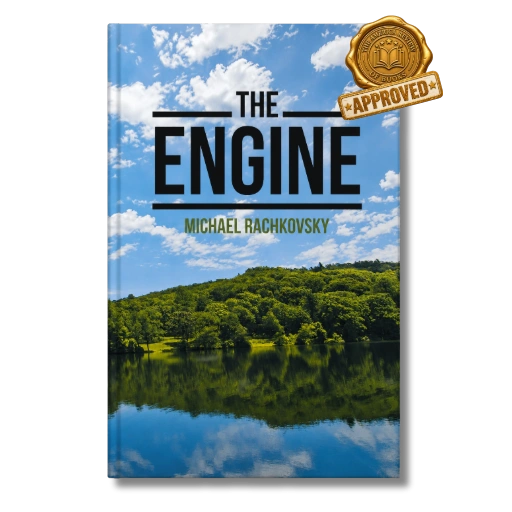
What if love is more than an emotion? What if it is not simply one feature of human existence, but the force responsible for pushing humanity toward its next stage of evolution? Michael Rachkovsky builds The Engine around this ambitious proposition, creating a novel in which romance, genetics, spirituality, philosophy, and the mysteries of consciousness intersect. At the center of the story are journalist Michelle Rosen and geneticist Sam Levitin, two people whose rapidly intensifying relationship becomes the doorway to questions far larger than either of their individual lives. Their attraction begins personally. Where it leads is anything but ordinary.
Rachkovsky’s philosophical foundation is clear from the outset: love and the human capacity to recognize beauty may represent some of biological evolution’s most significant achievements. In a world capable of extraordinary cruelty, love becomes not merely a comfort against darkness but, as the novel proposes, the “engine” behind human existence and survival. It is an audacious idea, and The Engine is most interesting when it allows readers to consider its implications.
When Romance Becomes an Experiment
Michelle and Sam provide two useful perspectives through which Rachkovsky can explore his larger questions. Michelle is a journalist, a profession naturally associated with curiosity, observation, and the search for hidden truths. Sam, as a geneticist, approaches existence through science and biology. Their relationship therefore becomes a meeting point between different ways of understanding reality.
But conventional explanations soon become insufficient. As their connection deepens, Michelle appears to possess abilities that seem mystical. Sam achieves something even more extraordinary: his Saint Bernard, Chook, begins to speak. It would be easy for such developments to turn the novel into pure fantasy. Instead, Rachkovsky uses them as provocations. The strange events surrounding Michelle, Sam, and Chook push the characters toward questions about consciousness, evolution, spirituality, and whether humanity understands nearly as much about existence as it believes it does. The scientific and supernatural begin occupying the same territory. That tension is one of the novel’s most distinctive qualities.
Science Meets the Spiritual
Science and spirituality are often presented in fiction as opposing forces. The Engine is less interested in forcing readers to choose between them than in imagining what might happen if each represents an incomplete understanding of a larger reality. Sam’s scientific background becomes especially important here. Genetics is fundamentally concerned with inheritance, variation, and the mechanisms through which life changes across generations. Rachkovsky takes that foundation and asks a speculative question: What if humanity’s next evolutionary development is not simply physical? What if consciousness itself can evolve? And what if love has something to do with it?
These questions take Michelle and Sam toward what the novel describes as a transcendental spiritual realm and eventually toward the possibility of breaching the barrier separating humanity from the Kingdom of the God of Love. The scale is enormous. The story begins with two people falling in love and expands toward an examination of humanity’s place in the universe. Readers looking exclusively for a conventional romance may therefore be surprised by the direction the narrative takes. The relationship is central, but Rachkovsky is interested in love as both an intimate experience and a universal principle.
The Meaning Behind the Title
The title The Engine becomes increasingly significant as the novel’s philosophy unfolds. An engine generates motion. It transforms energy into action. Without it, a machine remains stationary regardless of how elaborate its construction may be. Rachkovsky proposes love in much the same way. Civilizations can accumulate knowledge. Scientists can decode genes. Technology can become increasingly sophisticated. Human beings can learn more about the physical universe than any previous generation. But toward what end?
For Rachkovsky, intellectual advancement without love risks becoming empty. Progress without compassion can produce a more technologically capable civilization without necessarily producing a better one. That idea gives the book relevance beyond its romantic and speculative storyline. The novel asks readers to consider whether evolution should be measured exclusively through biological adaptation and survival or whether humanity’s capacity for empathy, beauty, sacrifice, and connection represents another form of advancement. It is an intriguing philosophical proposition because it transforms love from something humans feel into something humanity may actually need in order to survive.
A Novel of Big Ideas
The Engine is not a novel afraid of ambition. It reaches toward genetics, spirituality, consciousness, metaphysics, human evolution, romance, and the existence of God. Inevitably, a book attempting to accommodate ideas of this scale asks its readers to accept a considerable degree of speculation. That will be part of its appeal for some readers and a challenge for others. Those who prefer hard science fiction grounded strictly in established scientific principles may find the novel’s movement into mystical and transcendental territory demanding. Similarly, readers expecting an uncomplicated love story should know that Michelle and Sam’s romance is ultimately a vehicle for much broader philosophical exploration.
But approaching the novel purely in terms of realism misses its purpose. Rachkovsky is asking “what if?” What if consciousness contains possibilities science has not yet explained? What if seemingly impossible connections between living beings point toward something larger? What if evolution is unfinished? And what if humanity’s greatest evolutionary achievement has been present all along, hidden inside our ability to love?
Love in a Cruel World
Perhaps the novel’s most accessible idea is also its simplest. Human beings live in a world capable of extraordinary beauty and extraordinary brutality. History repeatedly demonstrates our capacity for violence, division, destruction, and indifference. Yet people continue to form families, create art, protect strangers, mourn those they lose, search for companionship, and sacrifice for those they love. Why?
The Engine treats that question with unusual seriousness. Love is not presented merely as romantic happiness. It becomes resistance to the darker possibilities of human nature. Michelle and Sam’s relationship therefore represents something larger than two people finding one another. Their connection becomes Rachkovsky’s argument for what might ultimately make human existence meaningful.
The Verdict
Michael Rachkovsky’s The Engine is an unconventional fusion of romance, speculative science, metaphysics, and philosophical fiction. Its greatest strength is its willingness to ask enormous questions. Rather than treating love as a subplot surrounding a scientific mystery, Rachkovsky places it at the center of his theory of humanity. Michelle and Sam’s extraordinary experiences lead readers from genetics and consciousness into increasingly spiritual territory, challenging the boundaries between what can be scientifically understood and what must still be imagined. Not every reader will accept the novel’s philosophical propositions, nor does the book require them to. Its value lies partly in provoking the questions themselves. Is consciousness merely biological? Can humanity continue evolving beyond its present state? Is our appreciation of beauty evolutionarily significant? Can science and spirituality describe different dimensions of the same mystery?
And above all: What if love is not simply part of human existence, but the reason human existence is worth preserving? That final question is the beating heart of The Engine. In a literary landscape filled with stories about humanity surviving through power, intelligence, technology, or conquest, Rachkovsky offers a strikingly different possibility. Perhaps our greatest strength has never been our ability to dominate the world. Perhaps it is our ability to love within it.
Rating: 4.5 out of 5 stars
Recommended for: Readers of philosophical fiction, speculative science fiction, metaphysical romance, spiritually themed novels, and stories exploring consciousness, human evolution, science, and the nature of love.