

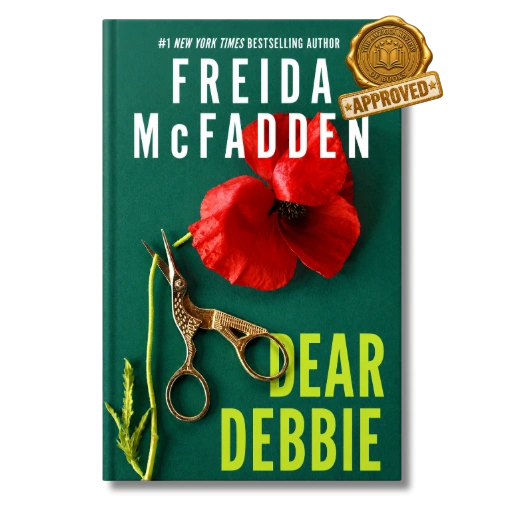
There is something inherently intimate, about asking a stranger for advice. A person writes down the problem they cannot solve, sends it away and waits for someone they have never met to tell them what to do. In Freida McFadden’s Dear Debbie, that familiar exchange becomes the foundation for something considerably darker.
McFadden, the bestselling author whose psychological thrillers have become synonymous with quick pacing and sharp reversals, builds Dear Debbie around Debbie Mullen, an advice columnist living an outwardly ordinary suburban life. She is a wife, a mother of two teenage daughters, and the woman readers turn to when marriages fail, relationships become dangerous, or life simply refuses to cooperate. Debbie is very good at telling other people how to mend their problems. Her own life is another situation.
After losing her newspaper job for giving a reader advice that crosses an uncomfortable professional line, Debbie begins moving beyond words. She has spent years hearing about cruelty, betrayal, predatory behavior, and people who seem to slide away from consequences. Now she starts wondering whether “advice” is enough. The answer she reaches is where Dear Debbie becomes deliciously unsettling.
A Different Kind of Advice Column
McFadden has built quite a lot of her reputation on protagonists who find themselves stuck in lives that look, you know familiar, for a while, until the whole thing quietly shows its disturbing foundation underneath. Dear Debbie works with that same formula, but it kind of wiggles it a bit, because Debbie is not just trapped in someone else’s dangerous little set up. At a certain point, she becomes the set up. Like, increasingly, she is the game, not the piece. And that distinction gives the book this wicked sense of fun, almost as if the story is smiling while it tightens the knot.
Debbie’s transformation also lets McFadden ask a thriller thing everyone loves, which is one of those moral questions: how far can someone go before “justice” turns into revenge? It gets messy, because Debbie does not really view herself as a conventional villain. She works through a personal moral code. She spots wrongdoing, she clocks who has been hurt, and then she grows more and more willing to hand out the consequences herself.
So the reader ends up in a kind of uncomfortable place. We’re shown clearly that her methods aren’t defensible. Still, McFadden knows exactly how to make us appreciate the fantasy behind it all: the deeply human want to see arrogant, cruel, manipulative, or abusive people finally meet consequences, like straightening the crooked mirror. That contradiction is basically the engine of the whole book.
Darkness With a Sense of Humor
What kind of keeps Dear Debbie from turning into this relentlessly grim thing is the dark humor, you know. McFadden seems to get it that a psychological thriller doesn’t have to be too self–serious all the time, if the goal is suspense. So here suburban respectability turns into this kind of fertile ground for satire. Book clubs, family ties, office maneuvering, old resentments, and those carefully kept appearances, all end up getting picked apart.
And honestly the jokes are part of why Debbie’s more and more questionable choices become strangely entertaining, even when they shouldn’t. There’s this switch, one minute you are kind of encouraged to sympathize with her irritation, and the next minute it reminds you you’re watching someone who can stretch that irritation into genuinely frightening extremes. That back and forth between amusement and alarm is, in my view, one of the novel’s best qualities. So, Debbie might not be the sort of person readers are supposed to admire. But she is, for sure, extraordinarily hard to ignore.
The Woman Behind the Answers
The most interesting part of Dear Debbie is not just, seeing what Debbie does next. It is kind of watching what occurs when a woman who has spent years straightening up other people’s issues finally decides she is not going to keep agreeing to the little rules that run her own life. Under the comedy there is anger. And then there is this, specific frustration about how women are supposed to stay helpful, accommodating, reasonable, emotionally available, even when everything around them is not.
McFadden takes those assumptions and pushes them right into thriller territory, like quietly but firmly. Debbie has listened. Debbie has advised. Debbie has tolerated. Then eventually Debbie acts. That does not automatically make what she does correct, but it does make it feel narratively satisfying in that deliberately awkward way that the best revenge thrillers somehow manage.
McFadden also gives her lead character a background that turns out to be more useful than you think: Debbie once studied computer science at MIT. And those skills just keep mattering more and more as she shifts from giving newspaper suggestions to investigating and intervening in the lives around her. The contrast works. The seemingly ordinary suburban advice columnist ends up having both the brainpower and the persistence needed to become a lot more dangerous than anyone expects.
A Thriller Designed to Keep Moving
If you’ve read McFadden you’ll probably recognize her commercial instincts right away. The novel is, basically, meant to keep moving. Chapters sort of nudge you into that familiar thing, like “just one more”, and you really start to believe it. Key information is managed in a careful way; more like held back than explained. The characters are not always, what they seem to be at first, and the ordinary parts of the story carry a real sense that danger could pop up suddenly.
That approachable tone is a big part of McFadden’s real appeal. These thrillers don’t ask readers to admire the whole design from far away. Instead, they pull you into the moment, and then they make it hard to walk out, like you’re stuck in the room with it. Dear Debbie did become a major commercial success after its January 2026 release, landing at No. 1 on Publishers Weekly’s overall bestseller list and hanging around those bestseller lists for months.
There is, though, a cost to all that steady escalation. As Debbie’s campaign starts gaining steam, some of the confrontations begin to fall into a recognizable rhythm. If you came for intricate procedural realism, or for a calmly paced literary psychological study, McFadden’s method may feel purposely heightened. But “restraint” isn’t really the goal. This is a revenge fantasy, wrapped up in suburban psychological suspense, and McFadden seems to know exactly what kind of book she’s writing.
How Far Is Too Far?
The most successful thrillers leave readers stuck in that back-and-forth, not just thinking what happened, but sort of what they would have done too. Dear Debbie seems to pull this off by leaning hard on its morally compromised protagonist, like you know they are not quite right, but you keep reading anyway. So, what happens when institutions fail people? What happens when wrongdoing gets to glide on by, like nobody is watching? And what happens when someone who has spent years advising others on how to manage their issues, suddenly decides that talk and language are no longer enough, at least not for them?
Then there is the uncomfortable one, the one that sits there. If a truly terrible person gets exactly what they deserve, through methods that are just as terrible, so who are we supposed to root for? McFadden does not have to hand over some neat philosophical answer, none of that. The payoff is in shoving the reader directly inside the contradiction. Debbie can be funny and also frightening. Sympathetic and unsettling. A victim, and then later an aggressor. An adviser, but also sort of the executioner. That wobbling instability keeps the character breathing on the page.
The Verdict
In Dear Debbie, Freida McFadden is operating pretty comfortably in that little zone that has sort of made her one of the most commercially successful names in modern psychological suspense: regular lives that keep, on the sly, a bunch of astonishing secrets, characters that are, well, disputable, things that escalate quickly, dark humor, and that ongoing promise that just when you think it’s settled, another reversal is waiting.
But then Debbie Mullen takes the same pattern, and does this mischievous sideways turn with it, like it can’t quite sit still. It’s not only, and not even mostly, the kind of tale where a woman’s life starts to unravel in real time. It’s more like, once she decides she isn’t going to allow herself to come apart she starts pulling at everyone else’s threads instead. What follows is dark, fast, provocative and, honestly, intentionally outrageous.
Some readers who insist on absolute realism might occasionally balk at the more excessive moments. But if you’re the sort of person who picks up a psychological thriller for morally questionable people, for revenge, for suburban secrets, for wicked humor and for that hard itch of curiosity : the one that says you have to turn the page right now – you’re going to have plenty to latch onto.
Because after spending her career telling everybody else what they ought to do, Debbie finally has some advice for herself. And nobody is ready for what occurs when she actually follows it.
Rating: 4.5 out of 5 stars
Recommended for: Readers of psychological thrillers, domestic suspense, morally gray protagonists, revenge stories, dark comedy, and twist-driven fiction.