

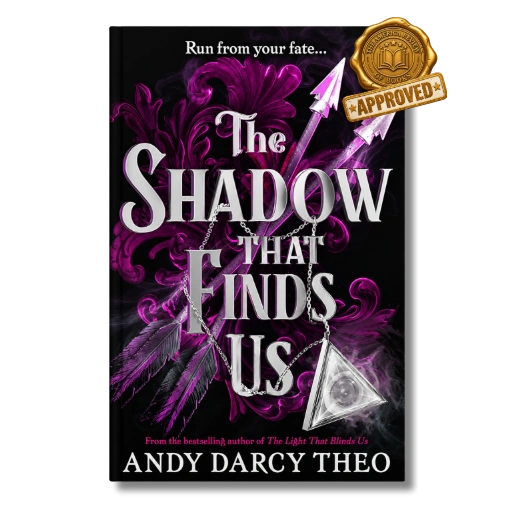
By the time you hit the third book, a fantasy series has a very specific problem. The world is already there, the main bonds have been made, and the mythology is basically running on rails. So, what’s left, is the heavier part, making readers care even more deeply about people they already think they know, and getting them to believe the risks coming next are bigger than the earlier pages, you know, bigger. In The Shadow That Finds Us, the third novel in Andy Darcy Theo’s Descent into Darkness series, the threat is not just about monsters, magic, or some supernatural reckoning that’s about to show up. A lot of the most disturbing ground happens, right inside the mind. After The Light That Blinds Us and The Dark That Hides Us, Theo follows Alexis, Blaise, Caeli, and Demi as they press forward toward Haven. But it is not this easy victory walk back. They reach home with the results of everything they went through, and those injuries, visible and invisible, start to steer the story from a very early point. For Alexis in particular, returning does not mean returning to safety. Whispering shadows begin intruding, upon his sense of reality, and the shadow man, a hallucinatory presence linked to his psychosis, again threatens the fragile boundaries between what Alexis perceives and what is really there. Meanwhile he is also looking for answers about his parents and a hidden secret that might fundamentally shift what he understands about himself. This is where Theo finds the novels most compelling tension.
Fantasy That Looks Inward
Fantasy often takes what’s going on inside and throws it outside. Fear turns into some kind of creature; grief becomes a lingering presence. Trauma ends up dressed as a curse that has to be unraveled, somehow. Theo plays with that old pattern and then makes it messy, in a good way. Alexis’s experiences with psychosis are not just decorative darkness, like a mood lamp in the background. They add real uncertainty to how things look, what can be believed, which memories are reliable, and even who someone is becoming. In a world where supernatural forces actually exist, working out whether a terrifying moment comes from magic, a mental health crisis, trauma, or a tangled mix of all three becomes incredibly hard. That uneasy ambiguity gives The Shadow That Finds Us, its psychological bite.
Theo brings an odd mix of real professional and personal context to these themes. He is a British-Greek Cypriot author, and he has a first-class degree in psychology as well as a postgraduate qualification in psychology teaching. He has also talked about what it was like working in a psychiatric hospital, plus the way family history keeps leaking into his writing. That background counts because the book is trying to do more than just hand a fantasy protagonist a mental health label. Theo keeps asking what it really means to trust your own mind, when that trust has been repeatedly questioned, maybe even worn down, over and over. The answer is rarely, if ever, straightforward. Alexis can be vulnerable without being turned into a single vulnerable thing, or reduced to it. His psychological pain does not wipe out his agency, his bonds with others, his wants, or his relevance inside the bigger fantasy arc. This contrast matters a lot, especially in young adult fiction, where mental illness can end up acting like neat shorthand for tragedy, or like a handy plot tool, that’s placed when it is needed.
A Found Family Beginning to Fracture
The novel’s emotional structure runs beyond Alexis, almost like the story keeps walking after that name. Blaise, Caeli, Demi, and Alexis have endured enough together that the well-known “found family” vibe in YA fantasy is already settled. But Theo gets that staying alive in the same place, does not automatically thicken bonds. Sometimes survival drags out the sorest areas, and then everyone has to stand there, no escape. There are still secrets. Some emotions have remained unsaid. Trust keeps tightening, harder to reach. Old emotional bruises from past conflicts start steering choices again in the present. So the Haven is more than just a location you can point to. Going back yanks these characters into the same room with versions of themselves they might rather abandon. That pleasure shows up in a later series book. Theo does not need to build the relationships from the ground. He can test them instead. Romantic tension, especially in those friends to lovers vibes, brings another kind of heat but it doesn’t fully swallow the big story. The relationships do matter, not only because the plot needs it but because the people themselves do, and affection gets messy fast when everyone is wrestling with fear, duty, destiny, and the very real possibility of losing someone. The coming autumn equinox gives the novel an outside clock, like a steady push, and it feels inevitable. Something heavy is on the way, so the characters have to grasp what they’re supposed to be doing before the night closes in on them.
Still, the larger fantasy conflict works best when it reflects what they keep fighting alone inside. The real question isn’t only whether they can beat the darkness. It’s whether they can spot it, and still refuse to let it become their definition.
The Psychology Behind the Magic
Theo’s background makes his way into fantasy pretty interesting, but in a way that feels almost accidental sometimes. Before he became known for the Descent into Darkness books and for showing up in online reading communities, he studied psychology, and then became a psychology educator. Per his literary agency biography, he still works part-time as the head of psychology at a school, or at least, that’s what they say. What is more, the real roots for this series go back to his adolescence. Theo has said that he started early drafts of the story somewhere around 13 up to 15 years old. Later, after a long gap, he returned to the same material again years afterward, during the COVID-19 pandemic. There’s something fitting about that history. A tale that was imagined during adolescence has grown with its author into a sequence that is concerned, rather specifically, with the sorts of questions that get more tangled once you’re older: Who are we when we are not living in our family’s orbit? How much of what happened before do we really take in? Can we rely on ourselves? What occurs when the people we love cannot fully grasp what we’re feeling inside?
The Shadow That Finds Us, consequently, feels pulled toward more than what its characters can do. It’s also drawn to how their experiences land on them afterward. That makes a difference.
A Darker Kind of Coming-of-Age Story
If you’re mostly here for fast moving fantasy spectacle you might notice Theo’s psychological and personal concerns need a lot more focus than the action alone. It’s a tale that spends time on emotional fallout, broken bonds, inner tug of war, and the way perception can wobble, even as the supernatural mythology stays in the background. For the right reader though, that attention is exactly what makes it stand out. The best young adult fantasy has always seemed to understand that adolescence itself can feel fantastical: identity shifts, relationships loom large, inherited expectations collide with what you actually want, and the future can look both dazzling and frightening at once. Theo takes those pressures and funnels them into a world where the darkness is real, but never just real. Generational trauma starts to really matter in that whole framework, and Alexis, he is looking for the truth about his parents, so you see a familiar human fear under all the fantasy machinery. The thing is that finding out where we come from could mess with what we think we are headed toward, what we believe we are meant to become.
Still, in Theo’s world, destiny does not always wipe out choice, you know. That push and pull is what gives the novel its emotional weight.
The Verdict
The Shadow That Finds Us is a darker, psychologically ambitious continuation of Descent into Darkness, and it treats fantasy not like a break from hard topics but more like a kind of language for looking at them. Andy Darcy Theo blends supernatural risk, found family, romance, mystery, and a coming-of-age arc with an unusually direct focus on psychosis, schizophrenia, trauma, and the tangled way perception and reality keep disagreeing with each other. The end result feels like the kind of book where the shadows work on more than one level at the same time. There are the shadows pressing in on the Haven. There are the shadows from family history, the ones that don’t stay quiet. There are the shadows that get thrown across friendship and love. And then, there are the ones that stick with a person in private, quietly following them into spaces where nobody else can really see what is happening.
That is ultimately what makes the title so effective. The Shadow That Finds Us feels like it means darkness does not always wait somewhere ahead. Sometimes it knows our history, sometimes it understands our fears. Sometimes it arrives wearing the face of something we thought we had already escaped, like we left it in the past.
For readers who are already invested in Alexis, Blaise, Caeli, and Demi, this third installment promises not merely another jaunt but a reckoning with everything the characters have carried into it. And for readers who are drawn to YA fantasy that takes the characters psychological lives just as seriously as its mythology, Theo’s series offers something increasingly valuable. Darkness with emotional consequence, and hope that does not ask anyone to pretend the darkness was never there.
Rating: 4.5 out of 5 stars
Recommended for: Readers of psychologically driven YA fantasy, found-family stories, darker coming-of-age fiction, friends-to-lovers romance, supernatural mysteries, and fantasy that explores mental health and generational trauma.