

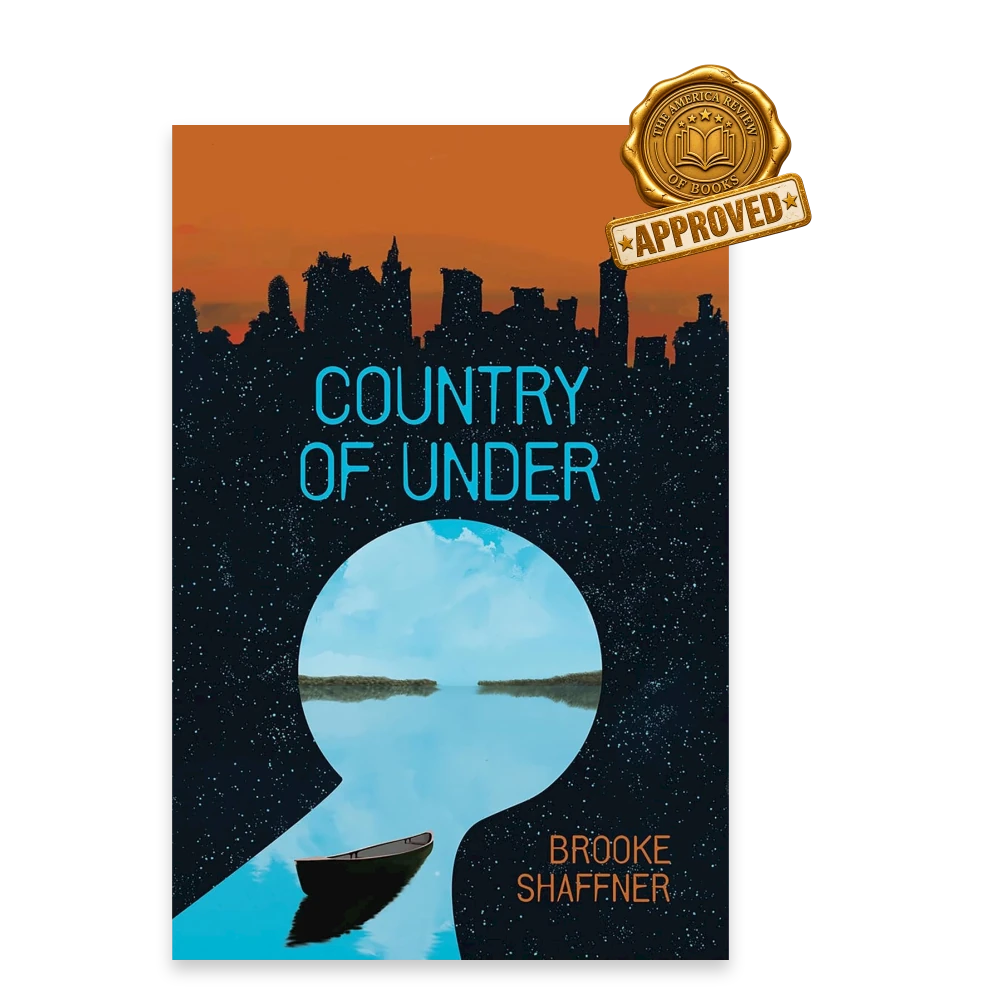
There are places we leave and places that never quite leave us. In Brooke Shaffner’s Country of Under, geography becomes more than landscape. It becomes memory, identity, desire, displacement, and the complicated question of where, and with whom – a person truly belongs.
At the center of the novel is Kat, a young woman shaped by a childhood in Key West and by a friendship that has followed her across years and borders. Her connection with Milo, a Cuban American boy whose life becomes intertwined with hers, forms one of the emotional foundations of the story. But childhood does not remain childhood forever, and the people who once seemed inseparable must eventually confront the different directions in which life pulls them.
Years later, Kat finds herself in Istanbul, teaching English and trying to create a life far removed from the place she once called home. There she meets a Syrian refugee named Ibrahim, and another relationship begins to challenge her understanding of intimacy, responsibility, culture, and belonging.
Moving through Key West, Istanbul, Cuba, and the emotional territories its characters carry within them, Country of Under is not simply a story about travel. It is a novel about people who live between worlds – and about the invisible borders that can be much harder to cross than the geographical ones.
When Home Becomes Complicated
One of the most compelling ideas in Country of Under is that home is not presented as a simple destination.
For Kat, home carries history.
It contains childhood, friendship, longing, and relationships that cannot easily be separated from the person she has become. Key West may represent familiarity, but familiarity does not necessarily mean certainty.
Shaffner understands that growing up often involves discovering that the places that formed us cannot always contain the people we become.
We leave.
We change.
We return differently.
And sometimes we spend years trying to understand whether home is somewhere we should go back to or something we must learn to carry within ourselves.
Kat's physical movement through the novel reflects this internal uncertainty.
She is searching, even when she may not completely understand what she hopes to find.
Kat and Milo: The Bonds That Shape Us
Kat's relationship with Milo gives the novel a powerful emotional history.
Childhood friendships can possess an intimacy that later relationships struggle to reproduce. They are formed before adulthood teaches people how much of themselves to conceal.
Milo is therefore more than another person in Kat's life.
He represents memory.
He represents a version of herself.
And through his Cuban American identity, his family history, and his own relationship with belonging, he also becomes part of the novel's larger exploration of culture and displacement.
Shaffner allows their connection to carry the complicated weight of time.
What happens when the person who knew you as a child encounters the adult you have become?
Can affection survive distance?
Can two people remain emotionally connected when their lives begin demanding different things from them?
And how much of love is really a desire to recover something time has already changed?
These questions give their relationship its poignancy.
Istanbul and the Possibility of Reinvention
Kat's move to Istanbul creates more than a change of scenery.
It offers reinvention.
Living somewhere unfamiliar can temporarily loosen the identities we carry at home. Nobody knows who we used to be. Our histories are not immediately visible. We can imagine ourselves becoming someone different.
But physical distance does not automatically erase emotional history.
Kat brings herself with her.
Her memories, unresolved relationships, questions, and desires cross borders just as easily as she does.
Shaffner uses Istanbul as a place where Kat can encounter both difference and herself. The city's position between continents makes it particularly appropriate for a novel fascinated by people who exist between identities, countries, relationships, and versions of home.
It is a place of crossings.
So is Kat.
Ibrahim and the Meaning of Displacement
Kat's relationship with Ibrahim complicates the novel's treatment of movement.
For Kat, living abroad can represent exploration and choice.
For a refugee, crossing borders may mean something entirely different.
That distinction matters.
Ibrahim's presence introduces questions about displacement that cannot be understood merely through the romantic idea of travel. Leaving one's country because one wants to experience another culture is fundamentally different from leaving because circumstances have made remaining impossible.
Through this contrast, Country of Under invites readers to think about privilege, mobility, and the different meanings attached to the word “home.”
One person can choose distance.
Another may have distance forced upon them.
Both may experience loneliness and alienation, but their journeys are not interchangeable.
Shaffner allows those differences to exist within the same emotional landscape.
Love Across Borders
Romance in Country of Under cannot easily be separated from geography.
Relationships occur across national, cultural, and emotional boundaries. Characters carry histories larger than themselves, and intimacy requires navigating those histories rather than pretending they do not exist.
This makes love complicated.
But perhaps love should be complicated in a novel about belonging.
To love another person is to encounter a world that existed before you entered it. Family, culture, language, memory, trauma, expectation, and identity all arrive with them.
Kat's relationships force her to confront that reality.
Connection is not simply about attraction.
It is about understanding what another person carries.
And understanding someone is considerably more difficult than wanting them.
Cuba, Key West, and the Geography of Memory
The proximity of Cuba and Key West gives the novel another fascinating geographical tension.
Places can be physically close while remaining separated by enormous political, historical, and emotional distances.
Shaffner uses these locations not merely as backdrops but as part of the characters' identities.
Cuba represents more than a country on a map. For characters connected to Cuban American experience, it can represent ancestry, family, history, absence, imagination, and questions about what it means to inherit a homeland one may experience differently from previous generations.
Key West similarly becomes more than a picturesque setting.
It is a threshold.
Water surrounds it.
Another country exists beyond the horizon.
The landscape itself seems to reinforce the novel's fascination with distance and connection.
The Countries We Carry Inside Us
The title Country of Under invites interpretation.
There are the countries visible on maps, defined by borders and governments.
Then there are the private countries people inhabit.
Childhood.
Memory.
Grief.
Love.
Longing.
Identity.
These invisible territories can shape a person as profoundly as nationality.
Shaffner's characters repeatedly occupy these spaces between the external and internal worlds. They belong somewhere, but perhaps not completely. They love people, but love does not automatically resolve the differences between them.
This ambiguity gives the novel much of its literary quality.
There is no easy definition of belonging because human beings rarely fit neatly inside definitions.
A person can love a place and need to leave it.
A person can leave a country and remain deeply connected to it.
A person can love someone and still be unable to build a life with them.
Contradictions do not necessarily cancel each other.
Sometimes they simply coexist.
A Novel About Becoming
Although geography, migration, culture, and relationships occupy much of the novel's landscape, Country of Under is ultimately also a coming-of-age story.
Not all coming-of-age stories belong to adolescence.
Adulthood contains its own series of awakenings.
There comes a point when the identities inherited from childhood are no longer sufficient. People must decide which parts of their past they want to carry forward and which they must release.
Kat's journey reflects this process.
She moves through countries, relationships, and different versions of herself while trying to understand where she belongs.
But perhaps belonging is not something waiting to be discovered.
Perhaps it must be created.
That possibility gives the novel its emotional resonance.
The Distance Between Leaving and Arriving
Travel narratives frequently celebrate departure.
Leaving represents possibility.
New places promise transformation.
But Country of Under is equally interested in what happens between departure and arrival.
That emotional middle ground can be profoundly lonely.
You have left one version of yourself behind but have not yet fully become another.
You may no longer feel completely at home where you came from, while the new place has not yet become yours.
It is a country without borders.
A country of under.
Shaffner writes into that uncertainty, allowing her characters to exist without forcing every contradiction into a comfortable resolution.
Final Verdict
Brooke Shaffner's Country of Under is a thoughtful, geographically expansive literary novel about belonging, displacement, intimacy, memory, and the complicated relationship between the places we inhabit and the identities we carry.
Through Kat's journey from Key West to Istanbul and through her relationships with Milo and Ibrahim, Shaffner examines different forms of distance—geographical, cultural, romantic, and emotional.
The novel's greatest strength lies in recognizing that crossing a border does not necessarily mean leaving the past behind.
People carry their histories.
They carry families.
They carry countries.
They carry old relationships and unfinished conversations.
And sometimes they spend years trying to determine which of those things constitute home.
Country of Under is therefore not simply a novel about where Kat travels.
It is about what she is searching for while she travels.
Love.
Identity.
Connection.
A place to belong.
Perhaps even permission to become someone different from the person she once imagined herself to be.
Shaffner's novel suggests that home may never be as simple as a point on a map. Sometimes it exists in another person. Sometimes it survives only in memory. Sometimes it must be built somewhere entirely unexpected.
And sometimes, before we understand where we belong, we must first learn how to live in the uncertain territory between leaving and arriving.
Recommended for: Readers of literary fiction, contemporary fiction, multicultural and international fiction, coming-of-age stories, novels about migration and displacement, and character-driven stories exploring love, identity, friendship, memory, travel, and the meaning of home.