

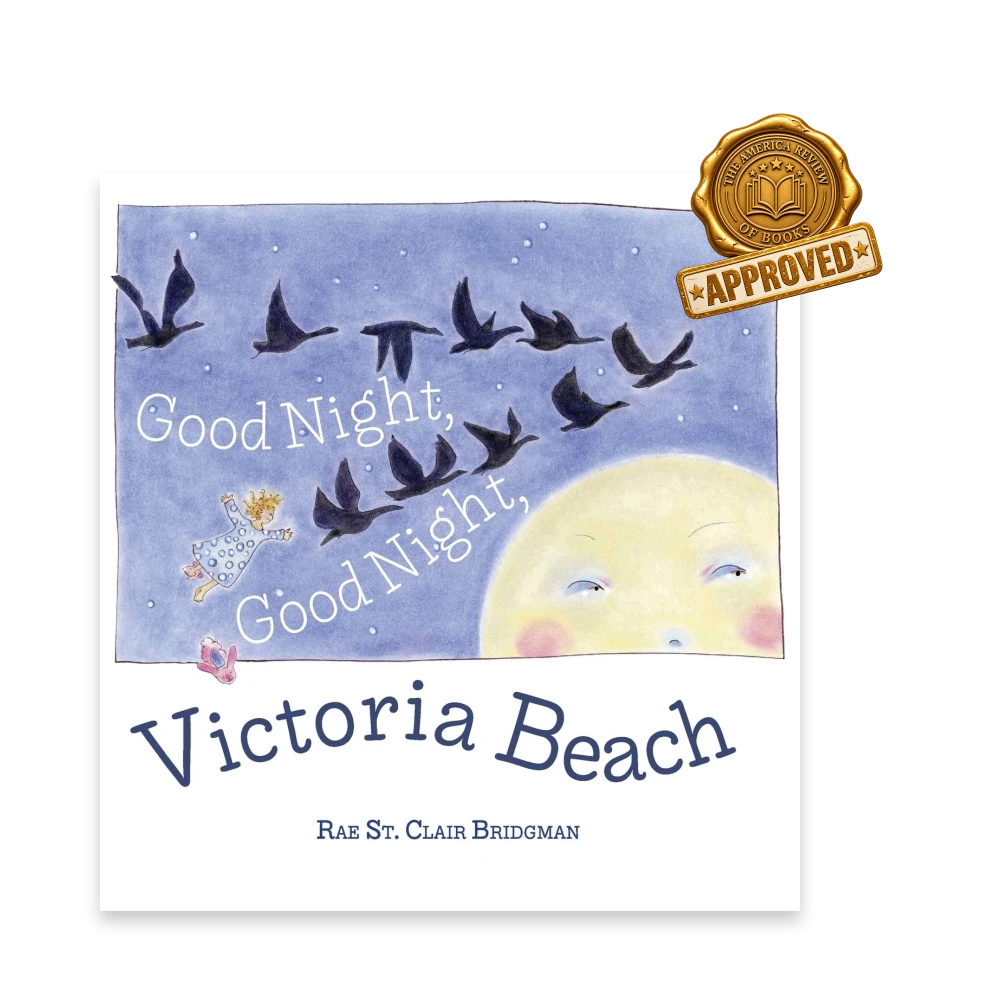
Sometimes the most memorable children's books begin with the simplest question.
What if a jackrabbit appeared at bedtime – and you decided to follow?
That playful possibility opens the door to Rae St. Clair Bridgman's Good Night, Good Night, Victoria Beach, a charming and unusually ambitious alphabet book that transforms the natural beauty of Victoria Beach, Manitoba, into a year-round adventure for young readers.
Inspired by a real half-white, half-brown white-tailed jackrabbit spotted at dusk after the season's first snowfall, Bridgman creates an imaginative journey populated by jackrabbits and a lively assortment of woodland, shoreline, and backyard companions. Woodpeckers, frogs, toads, voles, geese, fish, bears, dragonflies, robins, mosquitoes, ants, chipmunks, and hummingbirds all become part of a whimsical celebration of nature.
Yet this is more than an animal picture book.
Across more than 100 pages, Bridgman combines the alphabet, changing seasons, rhyming language, illustrations, observation, and bedtime-story comfort into a book designed to be explored rather than simply read once.
The result is a distinctly Canadian children's book that finds something magical in the ordinary pleasures of the natural world.
When the Alphabet Becomes an Adventure
Alphabet books have one deceptively difficult task: they must teach something children need to learn without making the experience feel like a lesson.
Bridgman approaches that challenge through play.
Rather than presenting isolated letters and objects, Good Night, Good Night, Victoria Beach takes readers on what might best be described as an alphabet amble. Letters become part of experiences connected to the seasons, surroundings, animals, and familiar childhood pleasures.
The alphabet therefore provides structure without overwhelming the imagination.
For young readers learning their ABCs, the repetition offers familiarity. For adults reading aloud, the rhyming couplets create rhythm. And for children returning to the illustrations, the animals and visual details offer opportunities to notice something new.
That layered approach is one of the book's greatest strengths.
It understands that young children rarely experience books in only one way.
They listen.
They look.
They point.
They repeat.
They search.
And eventually, they begin recognizing letters and words themselves.
Four Seasons, Four Different Worlds
One of Bridgman's cleverest decisions is to allow the alphabet to travel through all four seasons.
Spring, summer, autumn, and winter each transform Victoria Beach, giving familiar letters new surroundings and associations.
This provides young readers with more than alphabet practice. It introduces the idea that the natural world is constantly changing.
Animals behave differently. Activities change. Weather changes. Colors change. Even the emotional atmosphere of a place changes as one season gives way to another.
For children, these transitions can become an early lesson in observing the world around them.
Instead of treating nature as scenery, Bridgman makes it part of the story.
The result is a book that encourages curiosity. A child may begin by recognizing a letter and end by asking about a jackrabbit, bird, insect, snowfall, rainbow, or other feature of the landscape.
That is exactly the kind of learning a good picture book can inspire.
Follow the Jackrabbit
The jackrabbit gives the book its personality.
The inspiration itself feels like the beginning of a children's story: a strangely colored rabbit appearing at dusk after the first snowfall.
Bridgman takes that real-world observation and asks the imaginative question that children's literature asks so well:
What if?
What if the jackrabbit were more than something briefly spotted outside?
What if it appeared at bedtime?
What if you followed it?
Suddenly, an ordinary encounter with wildlife becomes an invitation into another world.
The jackrabbit's presence also provides a playful searching game. Readers can look for the adventurous rabbits as they make their way through the book, creating another reason for children to revisit its pages.
The author's own description of the illustrations makes this idea particularly delightful: paw prints appear near the beginning, while the rabbit eventually seems to hop away again at the end.
It creates the feeling that the animal has scampered through the entire book, briefly inviting readers into its world before disappearing again.
Illustrations Filled With Whimsy
Because Bridgman is both author and illustrator, words and images feel closely connected.
Her pen-and-ink and pan-pastel illustrations embrace fantasy without abandoning recognizable nature. Animals can be playful and expressive while remaining connected to the landscapes and seasons that inspired them.
This balance matters.
Children's illustrations do not always need realism to encourage an appreciation of the real world. Sometimes whimsy makes children look more carefully.
A rabbit becomes more interesting.
A dragonfly deserves another glance.
A chipmunk becomes a character.
A snowy evening becomes a possible adventure.
The artwork invites children to linger rather than rush from one letter to the next.
That quality makes Good Night, Good Night, Victoria Beach particularly suited to shared reading, when an adult and child can stop, point, talk, search, and invent stories beyond the words printed on the page.
A Bedtime Book That Also Teaches
There is a comforting contradiction at the heart of the book.
It is energetic enough to invite exploration but gentle enough to belong at bedtime.
Bridgman gradually brings the alphabetic journey toward familiar signals of sleep—yawns, dreams, hugs and kisses, and finally the reassurance of good night.
This gives the book a natural place in a bedtime routine.
The educational content never needs to announce itself as education.
Children encounter letters.
They hear rhyme.
They recognize seasonal patterns.
They discover animals.
They practice observation.
They develop vocabulary.
They experience repetition and prediction.
And all of it occurs inside the familiar ritual of sharing a story.
That makes the book useful not only for families but also for preschool classrooms, libraries, early-learning environments, and read-aloud sessions.
A Celebration of Victoria Beach
Although the book's setting is geographically specific, its emotional appeal is much broader.
Victoria Beach becomes the author's particular doorway into experiences familiar to many childhoods: watching animals, noticing the seasons, playing outdoors, exploring, seeing snow arrive, listening to birds, discovering insects, and finding adventure in places adults might overlook.
For readers familiar with Manitoba or cottage life, the setting may evoke recognition and nostalgia.
For readers thousands of miles away, Victoria Beach can simply become somewhere new to discover.
That is one of children's literature's quiet powers.
A book can make a local place universal without stripping away what makes it distinctive.
Bridgman does not need Victoria Beach to represent everywhere.
She allows it to remain itself.
And precisely because the affection for the place feels genuine, readers are invited to think about the places they love too.
A Book Designed for Returning
At 120 pages, Good Night, Good Night, Victoria Beach is considerably more substantial than the average alphabet picture book.
For some families, that may make it less suited to reading from beginning to end every single night.
But it also creates one of the book's unusual advantages.
There is plenty to return to.
A family might explore one season at a time. A child might search specifically for animals. Another reading might focus on letters. Another might become an illustration hunt.
In this sense, the book functions almost like several picture books gathered into one volume.
Repeatability matters enormously in children's publishing. Young readers frequently request the same books again and again, and the best read-aloud experiences give adults enough visual or verbal variety to continue discovering something alongside them.
Bridgman's combination of seasons, animals, letters, rhymes, and illustrations gives families multiple ways to experience the book.
Finding Magic in What Is Already Around Us
Perhaps the most appealing quality of Good Night, Good Night, Victoria Beach is its belief that wonder does not have to come from somewhere extraordinary.
It can begin with a rabbit.
A snowfall.
A beach.
A bird.
A puddle.
A changing season.
Or simply a child willing to look closely.
Bridgman has described her creative approach as finding the fantastical and whimsical possibilities within everyday life, and that sensibility is visible throughout this book.
Children naturally understand this kind of transformation.
A forest can become a kingdom.
Animal tracks can become clues.
A rabbit disappearing into the distance can become the beginning of an adventure.
Adults sometimes need children's books to remember how easily that transformation once happened.
Final Verdict
Rae St. Clair Bridgman's Good Night, Good Night, Victoria Beach is a warm, whimsical, and visually imaginative celebration of the alphabet, the four seasons, Canadian nature, and the extraordinary possibilities hidden inside ordinary childhood experiences.
Its greatest strength is the number of experiences Bridgman manages to bring together.
It is an alphabet book without being merely an alphabet exercise.
It is a nature book without becoming a textbook.
It is a bedtime story with enough energy and visual detail to inspire daytime exploration.
And it is a book about one particular Canadian place that can still speak to children who have never visited Victoria Beach.
The jackrabbits may lead the adventure, but curiosity is the real guide.
Children are encouraged to search the illustrations, listen to the rhymes, recognize letters, meet animals, observe seasonal changes, and perhaps look at their own surroundings with greater attention afterward.
That is a meaningful achievement for any children's book.
Because sometimes encouraging a child to love reading does not require an enormous adventure.
Sometimes it begins with a simple question:
If a jackrabbit appeared outside your window tonight, would you follow?
With Good Night, Good Night, Victoria Beach, Rae St. Clair Bridgman makes it difficult to say no.
Recommended for: Families with toddlers and young children, preschool and early-elementary readers, teachers, librarians, nature-loving families, and readers looking for alphabet books, Canadian children's literature, seasonal stories, animal picture books, and imaginative read-aloud bedtime books.