

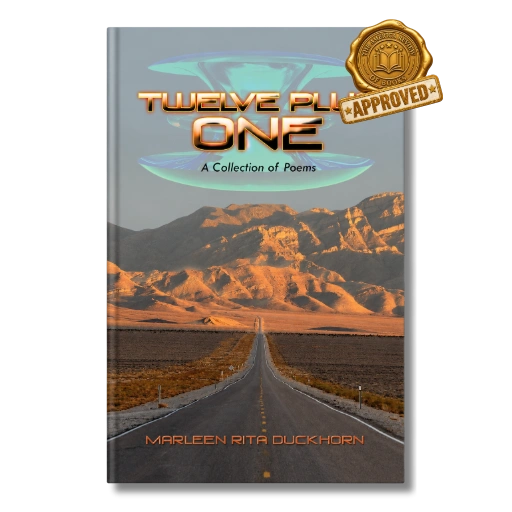
There is something wonderfully characteristic about a poet reaching a thirteenth collection and then deciding not to call it thirteen. Marleen Rita Duckhorn instead gives us Twelve Plus One: A Collection of Poems, a title with a touch of playfulness that feels like it hints at the temperament behind the pages. Still, beyond that little numerical wink there’s a book with expansive concerns. Across six sections, Duckhorn turns her attention to subjects that stretch from time and human existence to heaven, ascension, extraterrestrial possibilities, and the mysteries that seem to hover just beyond ordinary perception, like they are almost within reach but never fully named.
This is Duckhorn’s thirteenth published poetry collection. The number matters less than what it gestures toward: a writer who keeps coming back to poetry as a way of examining the world. Twelve Plus One is therefore not only another collection. It reads like proof of an ongoing, almost persistent conversation between poet, language, and lived experience.
A Poet Looking in Many Directions
Some poetry collections kind of organize themselves around a single emotional episode or a tightly set theme. Duckhorn takes a wider route, which I guess is a choice. Her six-part layout gives her a bit more space to slip between the grounded and the otherworldly, and it reads, not as a straight line, but more like turns. Alien spacecraft can share the same page with meditations on time, and somehow it fits. Questions about heaven and ascension can sit right next to quiet observations of human existence.
At first glance, the range might seem strange, but poetry has always been uniquely good for this kind of moving. It can wander in a way other forms usually can’t. A poem does not have to argue that another realm exists, to still wonder about it. It also does not need to crack the riddle of time to think about what those passing years actually do. Poetry gives writers permission to live in that in-between space, between certainty and imagination. Duckhorn seems comfortable there. Her poems ask readers to look upward, inward, backward, and beyond, all in the same breath, maybe even with a little delay.
The Freedom of Free Verse
Duckhorn writes in free verse. This approach works with the collection’s exploratory nature, and it keeps the whole book feeling awake. Free verse, without the strict obligations of traditional meter or rhyme schemes, puts extra weight on voice, imagery, rhythm, the way a line moves, and those especially stick-to-your-mind word choices. The poet creates a kind of structure rather than inheriting it, you know. It is less about following an older plan and more about steering attention as you go.
Duckhorn’s recognizable strength is in her turns of phrase, and they feel almost necessary, like she picked them up and set them down exactly where they belong. That matters because poetry often lasts in memory not as a full argument but as scraps, fragments of language. A phrase catches on. An image lingers, and a handful of words can suddenly name something the reader has already felt, but never managed to speak out loud. For an experienced poet, this skill of making language memorable becomes part of a personal signature, an unmistakable thumbprint in the sound and in the selection of images.
So, the description of Duckhorn as an “ever-evolving” poet is important. Thirteen books do not automatically mean thirteen repeats of the same artistic approach. Longevity gives the writer room to reexamine familiar subjects, again and again, but from different ages and different angles. Time changes the poet, plainly enough. And the changed poet, inevitably, changes the poetry.
Between the Cosmic and the Spiritual
Some of this collection’s most intriguing territory shows up right where the cosmic and the spiritual start to approach each other, a little more closely than expected. At first, alien spacecraft and heaven may seem like they’re talking about two completely different matters. One rises out of speculation about life elsewhere in the universe, the other grows from humanity’s religious and spiritual efforts to grasp existence after death. Still, both begin with a similar impulse. We look upward. We wonder what is there. Human beings have done this for thousands of years. The vocabulary shifts over time, from gods and heavens to planets and alien societies, yet the curiosity keeps returning, very persistent.
Duckhorn’s readiness to investigate both kinds of mystery gives the collection an airy, expansive quality. The poems do not have to land on a final verdict. Instead, their work is to hold an open space for wonder.
Time as a Poet’s Natural Subject
Time is particularly good ground for a poet with a real pile of published work already sitting there. Writing is this odd, everyday negotiation with time, and somehow it keeps going. A moment comes, and then it’s gone. The poet writes it down. Later on, someone else reads the lines and for a while steps into an experience that would have vanished completely. Poetry has this stubborn ability to keep youth, grief, love, uncertainty, hope, anger, curiosity, and recollection around long after that first moment has slipped away.
And for a writer putting out a thirteenth collection, questions of time start to feel even louder, more layered, in a way that can’t be avoided. Each new book lives beside what was written before it, not behind it, not instead of it. So, the outcome becomes more than just a bibliography, it’s more like a record of awareness moving through years, one after another.
Poetry as an Act of Sharing
Maybe the most direct thing to say about Duckhorn is also the thing that helps most in understanding this collection: she loves people and she wants to share her poems out in the world. There is a real sincerity in that urge, and it shows. Contemporary poetry can sometimes get so caught up with technique, theory, or literary experimentation that the basic relationship between writer and reader becomes a little unclear, as if it’s hiding behind the method. Duckhorn’s approach brings that back. Poetry is also communication, not just a puzzle. Someone writes because something asks for expression. Someone else reads because they want to recognize it, to discover it, to question it, or to feel something that reaches back. The poem sits there between them.
That need for connection helps explain the reach of Twelve Plus One. Its topics are broad because human curiosity is broad. We think about daily life, and we also think about death. We notice other people, but we also wonder whether life exists elsewhere, beyond our sight. We live in the present, while constantly revisiting the past and imagining what comes next. Poetry can carry these contradictions all together, without forcing them to behave.
Thirteen Books and Still Evolving
There is something admirable about ongoing artistic persistence. Publishing a single collection means you still have something to say. Publishing thirteen suggests more than a finish, it also feels like a steady need, to keep finding fresher ways to phrase what’s there. Twelve Plus One arrives from a poet who hasn’t decided that her earlier books used up everything poetry could offer, and Duckhorn keeps moving through new doors.
That long runway also changes how the collection can be approached. Each poem kind of holds its own, yet the whole book sits inside a much longer creative path. For people who already read her, it feels like another step in a voice that keeps growing, and revising itself. For newcomers, it works as a welcoming entry, to a poet who can shift from the inward and intimate into the vast, even when the subject turns cosmic.
The Verdict
Marleen Rita Duckhorn’s Twelve Plus One: A Collection of Poems is an eclectic, imaginative, and personal collection from a writer whose curiosity continues right into her thirteenth published volume. Set up in six parts and moving through topics like time, heaven, ascension, alien spacecraft, humanity, and the unknown, the collection won’t stay in just one little corner of experience, not even for a moment really. That wide reach is kind of the core of it, the identity too. Duckhorn writes like a person who is still asking questions, still looking around with a steady patience, still leaning toward “maybe”, and then trying the next phrase anyway. Still observing. Still wondering. Still experimenting with wording. And after thirteen collections, the faith remains that poetry is worth sharing, even when it could be easier to keep quiet.
If you are the kind of reader who wants highly formal verse, you might end up in a different neighborhood here. Duckhorn takes up the freedoms of modern free verse, and also that restless unpredictability of a mind that follows whatever a subject proposes, even if it detours. For readers who like poetry as exploration, that openness is part of the pull, the attraction.
Maybe the playful title tells more than it seems at first glance. Thirteen can end up as Twelve Plus One, not because the math changes, but because the poet decides to see it differently. Isn’t that one of poetry’s main goals? To take something familiar, a number, a moment, the sky, even time itself and make us look again at it as if for the first time?
Rating: 4.5 out of 5 stars
Recommended for: Readers of modern poetry, free verse, spiritual and philosophical writing, cosmic themes, reflections on time and existence, and poetry collections driven by curiosity, imagination, and an enduring love of language.