

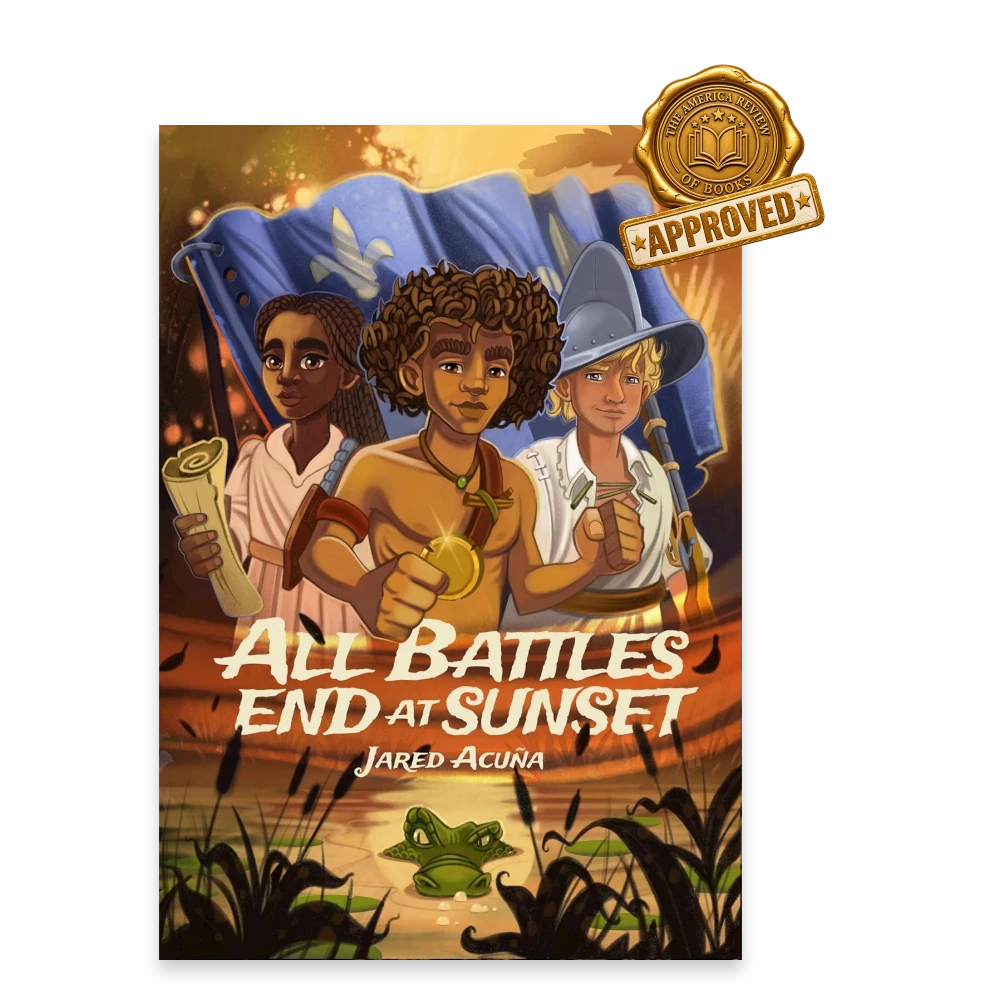
History can sometimes feel distant to young readers: a collection of names, dates, wars, and places belonging to people who lived centuries before them. Jared Acuña takes a different approach in All Battles End at Sunset. Instead of asking young readers simply to learn history, he invites them to step inside it.
The year is 1562.
Europe is divided by religious and political conflict. France is being torn apart by the struggle between Catholics and Protestants during what will become known as the French Wars of Religion. Amid that dangerous world lives Marcel, a courageous 12-year-old orphan whose life is about to become connected to events far greater than anything he could have imagined.
Marcel joins legendary French sea captain Jean Ribault and a group of Huguenots seeking something people throughout history have repeatedly risked everything to find: a place where they can live according to their beliefs without persecution.
Their destination is Florida.
But the New World does not promise safety simply because it is far from France.
There are unfamiliar landscapes, dangerous animals, Indigenous peoples whose world the Europeans are entering, and threats carried across the ocean by the very conflicts the Huguenots hoped to escape.
Through Marcel's eyes, Acuña transforms this overlooked chapter of history into an adventure about courage, friendship, faith, survival, and a boy discovering what it truly means to grow up.
History Through the Eyes of a Child
One of the strongest choices Acuña makes is placing a young fictional character among real historical people and events.
Marcel gives younger readers someone through whom they can experience history rather than merely observe it.
He does not know how history will remember 1562.
He cannot look ahead in a textbook to discover what happens.
For Marcel, history is simply life.
That perspective changes everything.
Religious conflict is no longer an abstract historical concept when people Marcel knows are being persecuted. Exploration is no longer represented by lines drawn across an old map when he is standing aboard a ship crossing an unpredictable ocean.
And the New World is certainly not an empty destination waiting to be discovered.
It is already alive.
By viewing this world through Marcel, Acuña gives historical events immediacy.
Marcel's Journey Toward Manhood
At the heart of the novel is a classic coming-of-age story.
Marcel begins as a boy who wants adventure and must gradually confront what adventure actually costs.
There is an important distinction between imagining bravery and needing to be brave.
The first is exciting.
The second can be terrifying.
Marcel faces dangerous journeys, confrontations with predators, uncertainty in unfamiliar territory, loss, difficult decisions, and circumstances in which courage becomes necessary rather than optional.
These experiences shape him.
Yet Acuña does not suggest that becoming a man means becoming fearless. Marcel's growth instead emerges through adaptability, responsibility, loyalty, and the willingness to act despite fear.
That makes his journey accessible to younger readers.
They may never cross an ocean with 16th-century explorers, but they understand what it means to face something unfamiliar and wonder whether they are strong enough.
Faith in an Age of Persecution
Religion is not simply historical decoration in All Battles End at Sunset.
It is one of the forces driving the story.
The Huguenots are not leaving France because they are restless explorers searching for excitement. They are seeking refuge from religious persecution.
That gives the voyage moral and emotional weight.
Acuña introduces younger readers to a period when questions of faith could determine whether people were accepted, persecuted, displaced, or killed.
Yet the novel's treatment of faith also operates on a personal level.
Characters must consider what they believe when those beliefs become costly.
Faith is easy to claim when nothing challenges it.
It becomes more complicated when maintaining it requires courage.
Marcel's journey therefore involves more than physical survival. His experiences invite questions about conviction, morality, mercy, and the kind of person he wants to become.
Across the Atlantic Into the Unknown
The voyage to Florida allows Acuña to embrace the adventure elements of historical fiction.
For a 12-year-old boy in 1562, crossing the Atlantic would represent an almost unimaginable journey.
The world ahead is uncertain.
Florida presents its own dangers and mysteries. The landscape is dramatically different from France, and the environment itself becomes part of Marcel's challenge.
Swamps conceal alligators.
Forests contain unfamiliar dangers.
Survival requires learning quickly.
Acuña uses these elements to create the kind of adventure likely to appeal to younger readers while grounding the excitement in historical circumstances.
The result is history that feels active rather than static.
Encountering the Timucua
Arrival in Florida also brings Marcel and the French explorers into contact with the Timucua people.
This encounter adds another important dimension to the story.
The Europeans may consider Florida a New World, but it is not a new world to the people already living there.
That distinction matters whenever historical fiction deals with European exploration.
Marcel enters a place with its own people, customs, knowledge, alliances, dangers, and history.
His experiences therefore involve not only surviving an unfamiliar landscape but learning how little he understands about the people inhabiting it.
The encounter creates opportunities for the novel to examine cultural difference alongside its broader themes of courage and faith.
Friendship in Dangerous Places
Marcel's relationships help prevent the historical backdrop from overwhelming the human story.
His friendship with Tristan is particularly important.
Adventure stories become more meaningful when danger threatens relationships readers have grown to care about. Friendship also provides Marcel with companionship as he moves through experiences far beyond ordinary childhood.
The two young characters can share fear, curiosity, humor, disagreement, and courage in ways that adults cannot always provide.
Their friendship reminds readers that history is ultimately made up of individual lives.
Behind every battle, expedition, religious conflict, or political decision were people who loved someone, feared something, hoped for a better future, and depended on others.
That human scale is where historical fiction often becomes most powerful.
When the Old World Follows You
Perhaps one of the novel's most compelling historical ideas is that crossing an ocean does not necessarily allow people to escape the conflicts they leave behind.
The Huguenots travel to Florida searching for refuge.
Distance promises freedom.
But history rarely permits such clean separations.
Political rivalries, religious divisions, imperial ambitions, and violence can travel with people.
The same forces that made Europe dangerous do not simply disappear because land has vanished beyond the horizon.
This creates an important tension throughout Marcel's adventure.
The characters are searching for a new beginning while carrying the consequences of the old world with them.
It is a pattern that appears repeatedly throughout human history.
People migrate hoping to escape persecution, conflict, or hardship, only to discover that creating a genuinely safe home can require more than reaching another shore.
Making History Feel Alive
Acuña clearly wants young readers to understand that history does not have to be boring.
His approach combines research with fictional storytelling, placing Marcel among people who actually lived and within events that really occurred.
That balance is crucial.
Historical fiction works best when imagination fills the spaces around history rather than replacing it.
Marcel can give readers an emotional perspective unavailable in historical records. Through him, young readers can imagine the fear of crossing an ocean, the wonder of encountering unfamiliar landscapes, the confusion of religious conflict, and the excitement and danger surrounding exploration.
The history provides the foundation.
The fictional character provides the doorway.
Together, they create an accessible introduction to a chapter of early American history many younger readers may never have encountered.
Courage Is More Than Winning a Battle
The title All Battles End at Sunset carries a meaning larger than physical combat.
Everyone fights battles.
Some occur between armies.
Others happen between religious factions, nations, cultures, friends, or within individuals themselves.
Marcel's most important victories are not necessarily measured by defeating enemies.
They are measured by what he learns.
Can he adapt when circumstances change?
Can he remain compassionate when frightened?
Can he protect others?
Can he hold onto his principles when doing so becomes difficult?
Can he experience hardship without allowing hardship to determine the kind of person he becomes?
These are questions that make Marcel's journey relevant centuries after the historical events surrounding him.
Final Verdict
Jared Acuña's All Battles End at Sunset is an ambitious and engaging work of juvenile historical fiction that successfully combines adventure, faith, coming-of-age storytelling, and a lesser-known chapter of early American history.
Through 12-year-old Marcel, readers experience the turmoil of 16th-century France, the religious persecution facing the Huguenots, the uncertainty of an Atlantic crossing, and the dangers and cultural encounters awaiting Europeans in Florida.
But Marcel's story is ultimately more personal than the historical events surrounding him.
It is about growing up.
It is about discovering that courage is not something a person possesses once and forever. It must be chosen repeatedly.
It is about friendship when circumstances become dangerous.
It is about faith when belief carries consequences.
And it is about confronting an unfamiliar world without knowing whether you are prepared for what waits beyond the horizon.
Acuña's blending of fictional characters with real historical people and events makes All Battles End at Sunset particularly valuable for younger readers who enjoy adventure but may not ordinarily reach for historical fiction.
The battles may belong to another century.
Marcel's struggles do not.
Fear, friendship, faith, uncertainty, resilience, and the desire to become someone worthy of the challenges ahead remain timeless.
Perhaps that is ultimately what makes history worth reading.
The world changes.
The battles change.
But the courage required to face them remains remarkably familiar.
Recommended for: Middle-grade and young-adult readers, families, homeschoolers, teachers, Christian-fiction readers, and anyone interested in historical adventures, the French Huguenots, early Florida history, coming-of-age stories, exploration, faith, friendship, courage, and survival.