
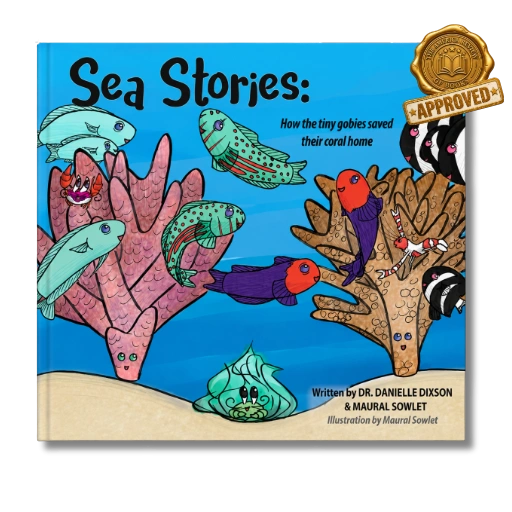
The ocean’s greatest heroes are not always its largest creatures. In Sea Stories: How the Tiny Gobies Saved Their Coral Homes, Danielle Dixson and Maural Sowlat turn a fascinating example of marine ecology into an accessible story for young readers. Against the spectacular backdrop of a coral reef, tiny gobies become unlikely defenders of the place they call home, and they bring children a key scientific idea: in nature, size has very little to do with significance.
Coral reefs are among the most diverse ecosystems on Earth. They provide food, shelter and breeding grounds for an extraordinary range of marine organisms. Still, these beautiful underwater communities are also vulnerable. Certain types of seaweed can harm corals when they come into contact with them, creating a threat not only to the coral itself, but to the animals that depend on it.
And then, the gobies. These small reef dwelling fish show this, really extraordinary bond with the coral they live in. When harmful seaweed starts threatening their home, the gobies kick in. What could look like a complicated lesson in ecological ties turns into this engaging little tale about neighbors looking after their own block.
That is also where Dixson and Sowlat’s concept work particularly well.
Real Science Told Like a Story
Good science writing for kids works best when it does more than list facts. It builds curiosity. Sea Stories pulls that off by turning marine biology into a scene young readers already understand: something dangerous has moved in, and the residents need to act.
Now the coral is not just an organism mentioned in a textbook. It becomes a living neighborhood, literally. The gobies are not only another fish species. They are active participants, involved in keeping the environment going. Behind that simple narrative there is a more complex ecological idea at work: species really don’t exist alone. I mean, life inside an ecosystem gets built through relationships, not in isolation. It follows then that one living thing’s survival can depend on another.
For young readers this is a good doorway into the interconnectedness of the natural world, even when it’s not said in a formal way.
The Smallest Heroes
There is also something strangely charming about putting gobies up front as the stars. Children’s books about ocean life tend to drift toward dolphins, sharks, whales, sea turtles and other animals people recognize right away. Gobies look much less dramatic on first glance though. And that is exactly why it works so well in this setting.
Their story pushes back against the belief that only the largest or strongest creatures matter. These tiny fish do an essential job in their surroundings, even with their small body size.
The takeaway lands beyond marine biology too. Kids are small in a world that’s mostly run by adults. If you show them a tiny animal that can actually help protect a whole home, it gives a hopeful implication, like: being small does not mean being unimportant, even when grown-ups seem to decide everything.
An Introduction to Conservation
This book’s environmental message is just as valuable, too. For children to care about protecting coral reefs, they must first understand why reefs matter. Facts can show the importance, but stories create a connection that sticks.
When Dixson and Sowlat present the reef as a home, not only a habitat, young readers get an emotional outline that helps them understand conservation. If the coral is harmed, then the creatures there are harmed as well. That easy link can become the start of bigger discussions later on, ocean health, biodiversity, pollution, climate change, and even environmental responsibility as children grow older.
Importantly, the story doesn’t need to overwhelm young readers with the massive scale of environmental problems. Instead, it starts kind of small with a fish, a piece of coral, and a danger creeping toward their neighborhood. That makes environmental science feel more reachable rather than scary, even a little.
A Book that Nudges Questions
Parents and educators will likely see real promise here. Once they finish reading, children may naturally start asking all kinds of things. Like, What exactly is coral? Why can seaweed harm it? How do gobies tell when their home is in trouble? What other animals cooperate in nature? What would become of everything if coral reefs faded away?
Those questions, in a practical sense are every bit as valuable as the answers.
A successful children’s science book should leave a young reader with at least one new idea. A great one should also leave the reader wanting more. Sea Stories: How the Tiny Gobies Saved Their Coral Homes has the potential to do both.
The Verdict
Danielle Dixson and Maural Sowlat took a truly remarkable ecological relationship and made it easy to reach, in a children’s story way. Sea Stories: How the Tiny Gobies Saved Their Coral Homes works to show coral reefs in all their complicated life, but it does it without making the whole topic feel too hard. The tiny gobies are not just cute characters, they also model teamwork and environmental back and forth, plus those astonishing adaptations that keep happening every single day under the water.
The message people remember most is also the most straightforward, almost like it slipped in quietly: No creature is too small to matter.
If you have kids who already lean toward animals, the ocean, or science, then the gobies give a welcoming first doorway into marine biology. For parents and teachers, this story can lead to real conversations about ecosystems and conservation, without needing a lecture that drags on too long. And for readers of any age, there is something uplifting about noticing that one of the ocean’s most interesting protectors is not a giant at all. It is a tiny fish, guarding its home.
Rating: 4.5 out of 5 stars
Recommended for: young readers, families, classrooms, aspiring young scientists, ocean enthusiasts, and anyone interested in coral reefs, marine biology, conservation, and the remarkable relationships found in nature.