

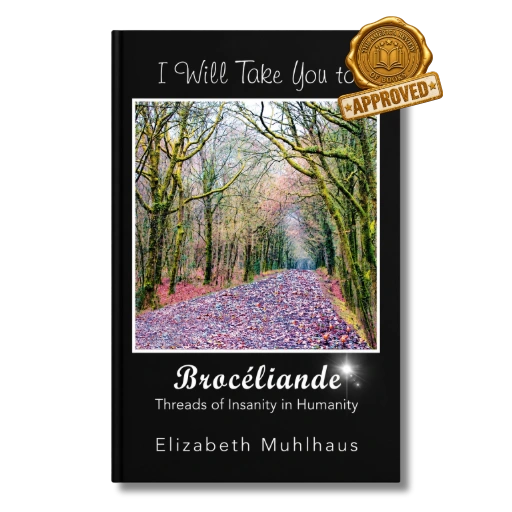
What if the search for peace starts not with asking how peace can be made, but with trying to understand why human beings keep, again and again, breaking it? This spicy turnaround idea sits right at the middle of Elizabeth Muhlhaus’s I Will Take You to Broceliande: Threads of Insanity in Humanity, a work that feels a little unconventional, it leans on the shape of a mystery. Part personal journey, part philosophical investigation, and part study of what human perception does, the book asks readers to walk after traces, toward a huge question, why does a species capable of love, beauty, and going beyond itself still prove equally able to harm, and to destroy?
Muhlhaus doesn’t treat the question like it can be held at a safe distance, like some clean abstract theory. Her inquiry stays tied to real moments, to hardship, careful noticing, pain, astonishment, and then to the slow realization that what seems unrelated may still carry patterns worth looking at. The result is a book, less interested in giving easy answers than in getting readers to look more carefully at the mystery, like genuinely. At times it feels a little… procedural, even if it never fully settles into one tidy path.
Humanity as a Detective Story
Muhlhaus describes her work as both a mystery and a detective story and that framing matters a lot, more than you might expect at first. Instead of starting with a conclusion and then building an argument around it, she treats understanding like an active pursuit of clues. Not just clues, but the noticing of them, the slight shift in perception. One lived moment leads toward the next. Mysteries stack up and deepen, and patterns show themselves slowly, sometimes late. The shape resembles a television thriller where tiny details, the almost boring ones, eventually carry greater weight.
But the case here is not a conventional crime. Humanity itself becomes the matter being examined. Peace is what has gone missing. Not peace as an idea only, but peace as something that can be taken, traded away, misplaced, and then felt as absence. So, the question keeps returning, what exactly keeps taking it away?
That just gives the book a strange philosophical range, because it does not stay on the surface. Talks about peace usually circle war, governments, ideology, economics, or diplomacy, and that is it. Muhlhaus goes a bit deeper, down to the psychological and perceptual drivers that nudge human conduct. Before peace can even be defended, she argues, we must grasp the workings by which peace ends up fragile.
The Meaning Hidden in Difficult Experience
One of the book’s more arresting notions is Muhlhaus’s reading of hardship. Instead of treating painful experiences only as things to beat, she asks what those moments do to perception, and how they reshape what she is able to notice. She even suggests a life made purely of comfort might never have built up the sensitivity needed to spot the faint cues she later began noticing in the world outside her. This is not a tidy praise of suffering. It is more complicated than that: an attempt to see whether difficult experiences can alter consciousness in ways that show dimensions of existence we used to miss entirely, or at least did not even think about.
The difference is important, really. Pain does not automatically lead to wisdom. Yet reflection upon that pain can shift how a person watches others, manages relationships, interprets settings and notices patterns of behavior that used to feel invisible. Muhlhaus then takes that heightened sensitivity and turns it into part of her investigation, like a method not merely a feeling. What are we overlooking because we have been trained to ignore it? How much information is actually there under ordinary conscious awareness, quietly waiting?
And if we start understanding those hidden influences, does it tell us something about why human beings keep acting against their own desire for peace, even when peace seems obvious? These questions pull the book away from memoir and toward philosophical inquiry, with that steady pressure of thought.
Darkness Beside Wonder
For a work subtitled Threads of Insanity in Humanity, the book is not consumed entirely by darkness, even if the shadows get plenty of space. Muhlhaus purposely sets moments of transcendence, love, innocence, and exhilaration right next to the hard parts, like it happens in real life. Her striking analogy about life’s bright instants as pecans sprinkled through cinnamon rolls, it really holds a key idea about the whole book. Darkness does not wipe out beauty, and beauty doesn’t cancel out darkness either. Both are happening at once. That push and pull gives the work its humanity, in a way that feels steady.
A book looking into why peace falls apart could easily turn grim. However, Muhlhaus keeps pointing your attention toward wonder, so the question becomes more layered: the human talent for destruction is only one side of the puzzle. People also love. People also build, make, and continue. People feel awe. People look for meaning. People notice beauty. So, any serious study of human beings has to include those traits too, not just the fractures. Because that central contradiction stays strong and a bit unsettling: How can the very same species that shows deep tenderness also unleash extraordinary cruelty?
Broceliande as Destination, and Symbol
Even the title carries an air of mystery. Broceliande is linked to the legendary forest from Arthurian tradition, a place in folklore where Merlin appears and where enchantment, mystery, and journeys beyond the ordinary live together. So inside the title, Broceliande means more than some geographic destination. It points toward entering another way of seeing. One might say it is a threshold. “I will take you” is not just a promise, it is an invitation. Muhlhaus asks the reader to come along, not only to receive conclusions, but to move through observations, lived experience, hints, and questions.
That is why the book’s structure matches its subject. The reader becomes less a passive receiver of an argument and more a companion investigator, or at least someone close enough to test the evidence.
A Book That Resists Easy Classification
I Will Take You to Broceliande is hard to slot comfortably into one single genre. It sort of carries elements of memoir, mystery, philosophy, spirituality, psychology, and social observation. Readers expecting a traditional detective novel should understand that the investigation is more conceptual than conventional, you know. Likewise, if someone is looking for a straightforward academic analysis of violence and peace, they will meet something more personal and intuitive instead. That genre fluidity, honestly, will be part of the appeal for readers who are comfortable with exploratory writing, the kind that doesn’t stay in one lane too long.
Muhlhaus is willing to move back and forth between external events and internal perceptions. Also, between suffering and transcendence, then again between observations of nature and questions about human civilization. The connections require attention; no one gets to skip them. Which is appropriate, because the book is built around clues.
The Search for Peace Begins with a Harder Question
Maybe the book’s most valuable contribution is its insistence that wanting peace isn’t identical to understanding it. Humanity has praised peace for thousands of years. Religions teach it. Political leaders invoke it. Families desire it. Nations build institutions supposedly intended to preserve it. And still conflict keeps coming back. Why is that?
Muhlhaus notices that merely saying peace is desirable does very little to explain why it remains so hard to hold onto, steady. Her method therefore starts with what breaks, not with what gets built. If we want to grasp what makes peace possible, maybe we have to first spot what makes it vanish. It feels uncomfortable, because the gaze shifts not only toward institutions or far away enemies but toward the human mind itself, directly.
The Verdict
Elizabeth Muhlhaus’s I Will Take You to Broceliande: Threads of Insanity in Humanity is an ambitious, and deeply personal study of one of civilization’s most persistent contradictions. In a way it’s structured around mystery and discovery, the book treats lived experience as proof and heightened attention as one way of tracking clues toward bigger questions, about human behavior. It doesn’t read like a straight road, more like you walk, then you notice things that were there already. Its best part is the curiosity. Plainly that’s what keeps it moving.
Muhlhaus doesn’t begin with the small stuff. Instead, she keeps circling back to peace on Earth. She wonders why people repeatedly erase what they say they want, which is a question that keeps landing in different places, not just one. She also asks whether hard experiences can tune perception, make it clearer, like an instrument that has been strained and then finally learned. And she invites readers to think about signals we usually step over, the overlooked cues, and whether those might show something meaningful about ourselves.
This isn’t a book for readers who expect a neat answer to humanity’s problems. The topic is too vast for tidy closure. It’s for readers who will investigate, to watch closely, to question, to join together strands that seem unrelated. And maybe, to accept that peace will keep slipping away until we recognize the forces, both visible and tucked away, that keep breaking it apart.
Muhlhaus takes readers toward Broceliande, not by promising certainty, but by giving small clues and breadcrumbs that add up in a strange way. The mystery waiting there is, in fact, humanity itself.
Rating: 4.5 out of 5 stars
Recommended for: Readers interested in philosophical inquiry, human behavior, peace and conflict, spirituality, consciousness, personal transformation, memoir-inflected nonfiction, and books that challenge conventional ways of understanding the world.