
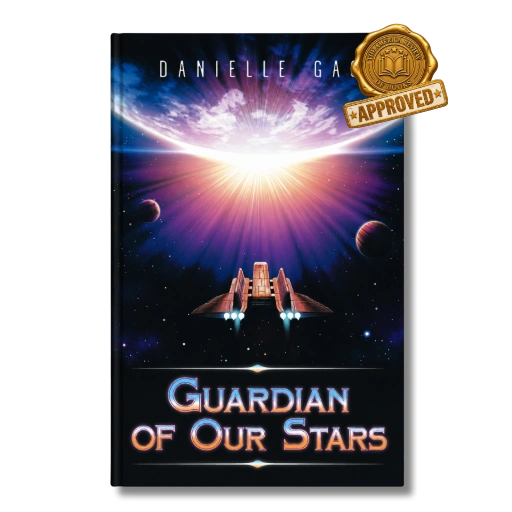
We think we know what aliens look like, or at least we think we do. For years, popular culture has been feeding us an image: enormous black eyes, green or gray skin, odd hands, bodies that seem unfamiliar. But what if our expectations are exactly the thing that keeps us from noticing something extraordinary when it is right there in front of us, looking back.
Danielle Gao’s Guardian of Our Stars opens with that inviting idea, and then Bree and Quinn, her cousins in the story, get pulled into an adventure. It starts with a weird find in the woods, and then it keeps widening until it becomes a trip across the galaxy, faster than anyone would guess.
At first, the mystery feels almost local. Bree and Quinn come across a small facility tucked among the trees. Finding an unexplained building would already be unsettling. Realizing it is inhabited changes the whole temperature of the situation. The residents are Minervans. And they look, annoyingly, almost human.
From that moment Guardian of Our Stars starts to undo the boundary between the cousins’ normal days and this much larger cosmic chronicle. At first, it feels like a brush with the unknown, you know, but then it turns into something more personal. Bree and Quinn might be tied to those ancient extraterrestrial presences in a way they could never have imagined.
A Mystery That Keeps Growing
One of the most satisfying parts of Gao’s premise is the way it escalates, not just the plot but the feeling in your chest as it moves forward. A building turns into a puzzle. The puzzle turns into an encounter. The encounter turns into a crossing through space. And that crossing makes Bree and Quinn rethink what they believe about themselves, even the simple stuff.
The structure works well for speculative adventure because every new reveal opens another doorway. Instead of dumping a whole gigantic universe at once, Gao begins with something you can touch. Two cousins walking into a place they do not understand. Readers learn the wider world right alongside them.
Soon the familiar landscape of Earth starts to give way to robots, mysterious stories, unfamiliar worlds, ancient aliens, and a planet that looks like it is about to fall apart. The scale expands a lot, but the cousins stay as that emotional anchor, the thing you keep returning to. The stars are enormous, obviously. But the story stays personal, which is maybe the point.
When Aliens Look Like Us
The Minervans are especially interesting, because they challenge one of science fiction’s most recognizable assumptions, the one you expect without noticing it. We expect extraterrestrials to look alien. Gao instead presents beings whose human-like appearance immediately complicates the mystery. Their familiarity becomes more unsettling than any obvious difference ever would.
If these beings resemble humans, then why? What is their history? And why do Bree and Quinn’s seemingly ordinary lives feel connected to them, from the first pages? Those questions turn the Minervans from strange creatures into pieces of a much larger puzzle.
The idea also brushes up against one of science fiction’s oldest hooks, the possibility that humanity’s timeline might reach past what we currently know about Earth. Ancient extraterrestrial cultures, half-remembered connections, and cosmic lineage, all provide really good material for imagination to get its feet in.
A Universe Meant for Wonder
Science fiction often shines most when it brings back our feeling for scale. Everyday worries can feel massive until a story places those worries next to planets, civilizations, and galaxies. Guardian of Our Stars captures that sense of wonder. Robots and strange worlds bring the pleasures readers expect from a space adventure, while mysterious tales give a bit more of history to the bigger universe.
The galaxy does not feel like it just started the moment Bree and Quinn walked into it. There are already things happening, civilizations with their own timelines, and results that were there long before the cousins understood even a fragment of them.
Most compelling is the doomed planet waiting for them. A world facing destruction changes the stakes fast. Discovery is no longer just exciting. It feels urgent, like the clock is already running. The cousins have to meet a reality that is a lot removed from the relative normality of everyday life.
Looking Beyond Appearances
Under the adventure, Guardian of Our Stars carries an inviting theme about assuming things. The opening idea, well, it hits right away. We tend to assume we already know what an alien should look like. Then the Minervans show up. That straightforward reversal pushes something wider, like a lesson you do not notice until later.
What we think we expect to see can, yes, steer what we end up recognizing. Maybe the difference is tucked under familiarity. Maybe the connection is there where we expected clean separation. The unknown also might not always announce itself by looking odd.
For younger science-fiction readers especially, this area is rich. The story encourages curiosity instead of fear about what sits beyond the familiar. The universe stays mysterious, yet the mystery turns into an invitation.
The Verdict
Danielle Gao’s Guardian of Our Stars is a creative science-fiction journey built around discovery, family, cosmic mystery and a hard-to-ignore question about how humanity relates to the stars. Bree and Quinn start with this unexpected building out in the woods, and then somehow, they get pulled into something almost too huge to imagine.
The book’s strongest hook feels like this idea that the extraordinary might be nearer to everyday life than anyone is willing to admit. What if aliens do not resemble anything we expect? What if humans are linked to civilizations beyond Earth in ways we never noticed? What if meeting another world means also uncovering something about ourselves?
Those questions keep fueling science fiction for generations, because they hit a core need most of us carry, which is to know if we are really alone, and if we are not then what our role might be in something endlessly larger.
Guardian of Our Stars walks into that mystery through the eyes of two cousins who never planned on leaving their familiar world behind. Their discovery suggests that sometimes, the greatest adventure begins not with a spaceship or a distant planet, but with something quieter. Sometimes it starts with a strange, small building hidden within the woods.
Rating: 4.5 out of 5 stars
Recommended for: Readers who enjoy science-fiction adventures, alien civilizations, space travel, robots, cosmic mysteries, family-centered stories, ancient secrets, and imaginative journeys into unknown worlds.